 Nations Unies
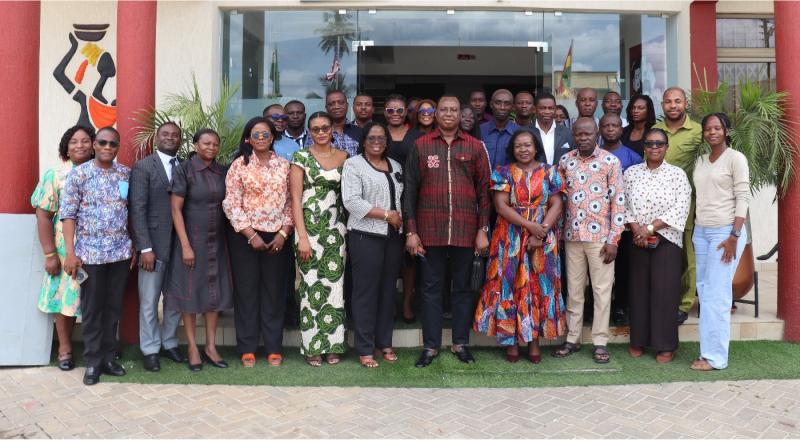
Business activity must never come at the expense of human dignity. Guided by this principle, Ghana's national human rights institution is strengthening its capacity to ensure that companies operating in the country respect human rights, and that victims of business-related abuses can access effective remedies. With technical support from OHCHR, Ghana's Commission on Human Rights and Administrative Justice (CHRAJ) has reinforced the capacity of its dedicated Implementation Support Committee, tasked with driving forward the National Action Plan on Business and Human Rights (NAP BHR). Delivered within the framework of the GIZ BHR Africa Project, this support drew on lessons from Kenya and on experiences from across Africa, Europe and Latin America to sharpen Ghana's approach to embedding human rights at the heart of business conduct.
From 19 to 20 March 2026, OHCHR supported a capacity-building workshop in Accra bringing together 30 participants, including 12 women and 18 men, among them members of the NAP BHR Implementation Support Committee. Established by CHRAJ, the Committee draws on staff from across the Commission's departments and units and now stands as the national human rights institution's dedicated mechanism for implementing the NAP BHR. It will provide technical guidance, coordination, monitoring and facilitation support to the public institutions, civil society organizations and other partners responsible for delivering the Plan's commitments.
Over two days, the workshop underscored the Committee's central role in translating Ghana's NAP BHR into tangible protection for people. Participants examined how to engage stakeholders meaningfully, raise awareness and build capacity among duty-bearers and businesses alike, monitor the human rights impacts of business activity, facilitate victims' access to remedy, and support companies in carrying out human rights due diligence.
A highlight of the training was a detailed account of Kenya's experience implementing its own NAP BHR, presented by Ms Claris Ogangah, Chairperson of the Kenya National Commission on Human Rights (KNCHR), who spoke candidly about both achievements and obstacles encountered along the way. OHCHR's Regional Office for West Africa complemented this exchange with sessions drawing on good practices from national action plans across Africa, Europe and Latin America, broadening the Committee's perspective beyond a single national experience.
The discussions were far from theoretical. Participants identified concrete practices to adapt to the Ghanaian context, including decentralizing NAP BHR implementation so that local government and community actors are genuinely involved, strengthening the monitoring of business-related human rights impacts, reinforcing corporate human rights due diligence, and ensuring regular reporting on business and human rights, both nationally and through international human rights mechanisms.
Beyond the immediate exchange of knowledge, the workshop helped CHRAJ turn practices from diverse national contexts into priorities suited to Ghana's own realities, while opening a lasting peer-learning channel between the national human rights institutions of Ghana and Kenya, with a set of practical follow-up actions now agreed.
This engagement was supported by OHCHR's Regional Office for West Africa, in coordination with the OHCHR Business and Human Rights Unit in Geneva, within the framework of the GIZ BHR Africa Project, and in collaboration with CHRAJ and Oxfam in Ghana.