 Nations Unies
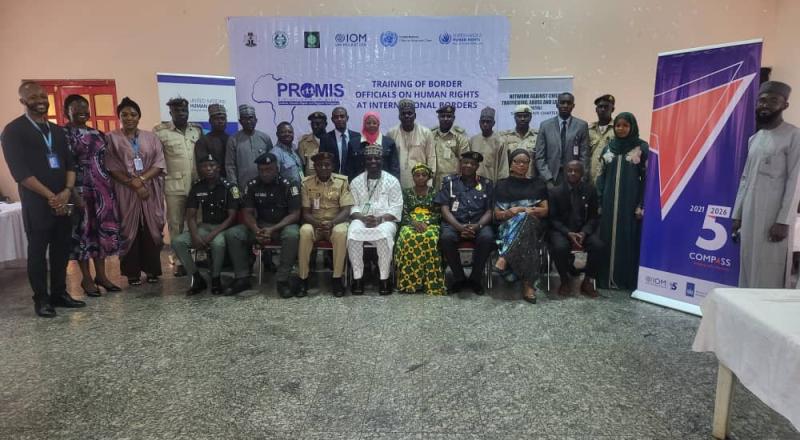
Border officials, human rights institutions, UN agencies and civil society actors meet in Sokoto to strengthen protection-sensitive border management, improve the identification of migrants in vulnerable situations and reinforce inter-agency referral arrangements at Illela Border.
On 20–21 July 2026, the Office of the United Nations High Commissioner for Human Rights (OHCHR), through its Protection of Migrants project (PROMIS), joined the National Human Rights Commission (NHRC) in convening a two-day training on Human Rights at International Borders in Sokoto State. The initiative reflects a shared conviction that effective border management and the protection of human rights are not competing priorities, but complementary pillars of good governance.
The training brought together 28 participants (26 men and 2 women) representing the full spectrum of actors involved in border governance: officials from Port Health Services, the Department of State Services, the Nigeria Immigration Service, the Nigeria Police Force, the National Drug Law Enforcement Agency, the Nigeria Security and Civil Defence Corps and the Nigerian Airspace Management Agency, alongside members of the National Working Group on Human Rights and Migration, including the NHRC, the National Agency for the Prohibition of Trafficking in Persons (NAPTIP) and the Network Against Child Trafficking, Abuse and Labour (NACTAL). Technical and financial support was provided by the United Nations Office on Drugs and Crime (UNODC) and the International Organization for Migration (IOM).
Opening the training on behalf of the NHRC Executive Secretary, Deputy Director Jennifer Aga underscored that “border security and the protection of human rights are mutually reinforcing objectives, noting that respect for human rights strengthens public trust, accountability and effective governance at borders”. OHCHR Human Rights Officer Esther Michael Sawa described the training as a practical, participatory space where border officials and protection actors could jointly examine operational challenges and identify workable, rights-compliant solutions.
Over the course of two days, participants explored the human rights dimensions of migration governance, addressing trafficking in persons and the smuggling of migrants, gender-responsive approaches to border management, and the identification of migrants in vulnerable situations. Discussions extended to immediate assistance, respectful screening and interviewing practices, alternatives to detention, rights-based approaches to return, and the mechanisms needed to ensure effective referral between agencies. Rather than treating these as abstract standards, the training grounded them in the daily realities faced by officials working at Nigeria's borders.
This grounding came alive through role plays and facilitated exercises, which allowed participants to translate human rights principles into concrete action: recognizing possible indicators of trafficking, prioritizing urgent medical and protection needs, conducting screening that is both respectful and private, safeguarding confidentiality, and making timely referrals. A concluding plenary session mapped the protection and assistance services available in Sokoto State and examined how referral processes currently function at Illela Border. Participants candidly identified gaps, in referral documentation, case feedback, the handling of travel documents, transportation, temporary reception and emergency assistance, and committed to sustaining coordination through institutional focal persons, periodic border-level meetings and a dedicated referral contact directory for Illela.
Building on the momentum of the training, a multi-stakeholder team comprising representatives of the NHRC, NAPTIP, NACTAL and the National Commission for Refugees, Migrants, and Internally Displaced Persons (NCFRMI) conducted a human rights assessment and monitoring mission at Illela Border on 23 July 2026, translating training commitments into direct field verification.
The mission confirmed that existing referral and protection arrangements, involving border agencies, civil society organizations, transport unions, traditional leaders and community structures, offer an important foundation for assisting migrants in vulnerable situations. At the same time, stakeholders raised serious concerns that merit continued attention: the persistent use of unofficial crossing routes, allegations of harassment and extortion at official crossing points, and limited awareness among migrants of their rights and of available complaint mechanisms. The assessment further pointed to gaps in gender-responsive and disability-inclusive services, inadequate reception facilities, and referral procedures that remain inconsistently applied. As an immediate output from the human rights monitoring mission and assessment, NIS referred three young persons identified in connection with a suspected trafficking case to Save the Child Initiative Nigeria for protection support and onward referral to NAPTIP for further investigation and case management.
Pre- and post-training assessments showed clear learning gains at the group level, with participants demonstrating a stronger understanding of protection assessments prior to return, the principle of immigration detention as a measure of last resort, gender-responsive border management, and the practical mechanics of effective referral.
Participants affirmed the relevance of the training to their day-to-day responsibilities and called for step-down training to reach additional frontline officers. Their feedback pointed to a common conclusion: sustained collaboration among border agencies, human rights institutions, civil society organizations and community structures remains essential to ensuring that border management in Sokoto State, and beyond, is secure, well-coordinated, and firmly grounded in respect for the rights and dignity of every migrant.